capinorium · Article · AI
Physical AI without the humanoid hype: what cobots can do for small batch sizes today

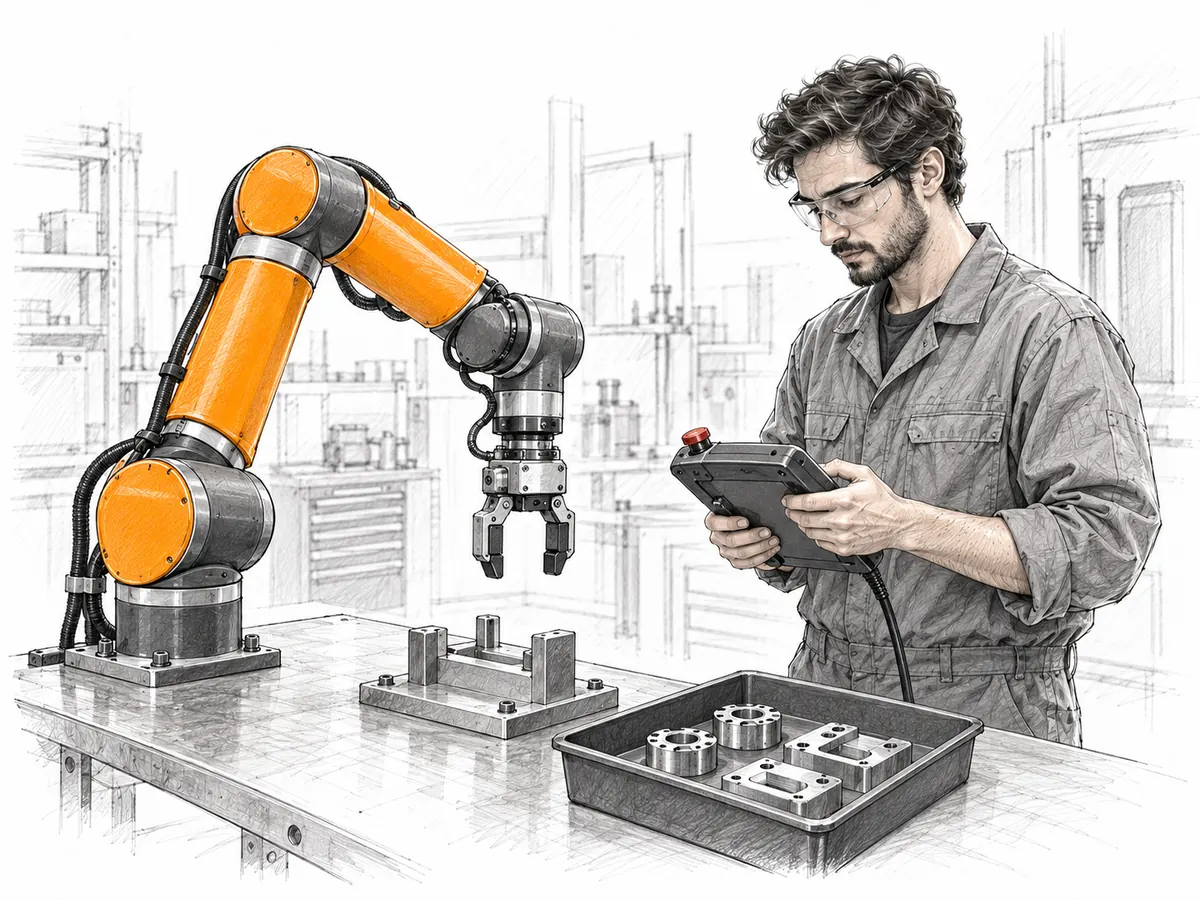
For manufacturers with small batch sizes, physical AI today is above all a tool that makes collaborative robots (cobots) quicker to switch to new parts and variants: AI vision for gripping, simulation before purchase, and programming by demonstration or natural language. For the foreseeable future, humanoid robots are more likely to complement existing automation than replace it; robust, independent data on economic viability are still lacking for both routes.
The starting point is sobering. According to KfW Research, only 1 % of German mid-sized companies used "AI for the autonomous movement of machines" – for the period 2022 to 2024, i.e. before the latest wave of announcements. KfW attributes this to the fact that (industrial) robots only pay off in mass production. This is exactly the threshold physical AI is meant to lower. Nor does the market show a boom: according to IFR data, around 24,800 industrial robots were installed in Germany in 2025, 8 % fewer than in the previous year. At the same time, the International Federation of Robotics (IFR) names small and medium-sized enterprises as a growth area, driven by cheaper robots that are easier to program. The question for management and production managers is therefore not whether the humanoid is coming, but which part of the technology actually reduces the effort per variant today.
Humanoids are an outlook, not an investment case for 2027
Neutral bodies are remarkably united. According to a report on its current study, Fraunhofer IPA considers it unlikely that humanoids will replace existing robotics solutions in the short term; industrial robots, cobots and automated guided vehicles are superior in productivity and cost in many applications. "Demonstrations must not be confused with mass adoption," it says. The IFR explicitly calls the timing of mass adoption uncertain. Even among large companies, according to Capgemini, only 4 % operate physical AI at scale.
A seemingly contradictory figure comes from Bitkom: 6 % of the industrial companies surveyed with 100 or more employees said they were already working with humanoid robots. This is a self-report gathered by telephone; whether it means testing, piloting or production remains open. It is not evidence of series deployment.
The layer beneath the hype is mature
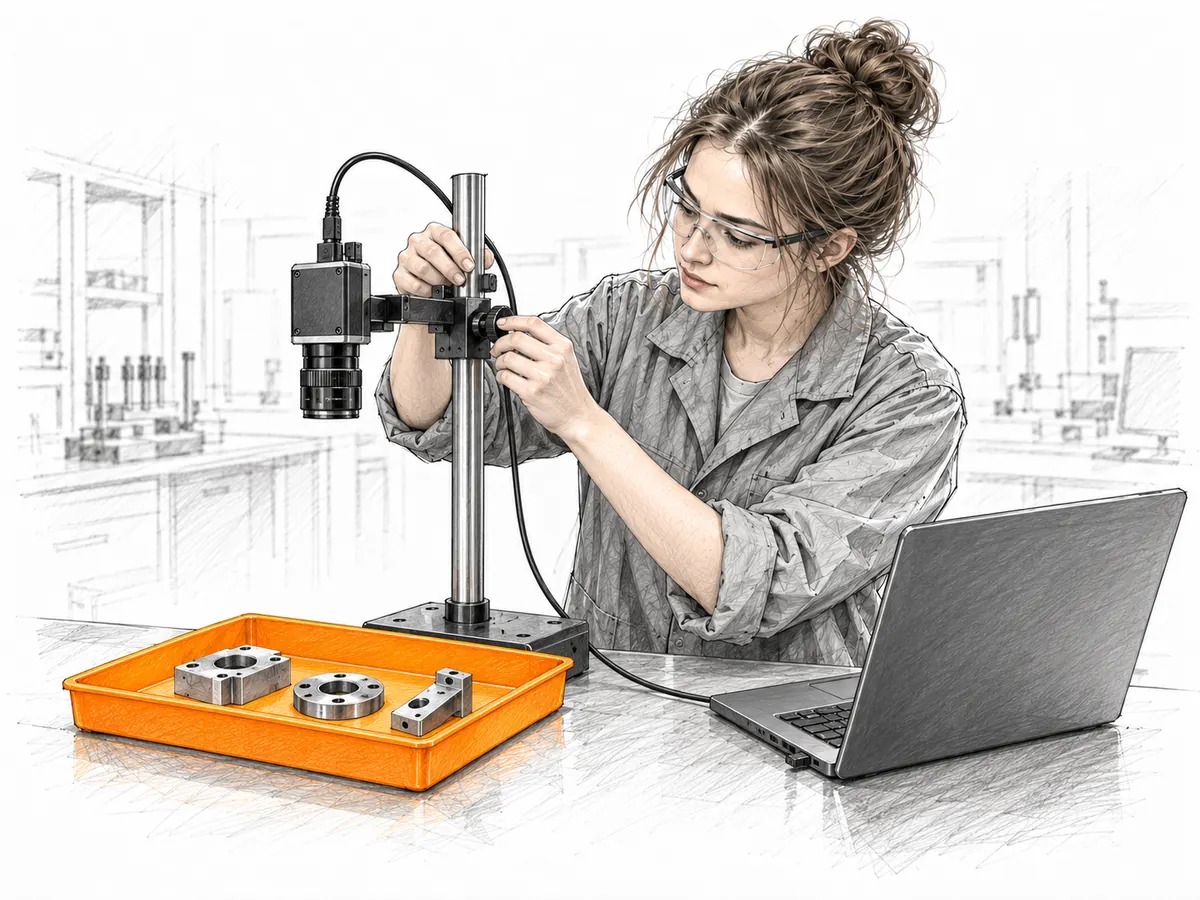
What has changed technically concerns perception and programming first. The IFR describes how advances in AI, vision and sensors are extending robot capabilities and how simpler programming is lowering deployment costs. For small series this means in concrete terms: camera systems recognise randomly arranged parts, simulations check reach and cycle time before hardware is ordered, and platforms such as Wandelbots NOVA allow natural-language input across robot brands, according to the manufacturer's description. In the case study of a supplier described there, simulation showed that a second robot costing around 100,000 euros would only have saved about one second of cycle time – also a manufacturer's claim, but a good indication of where simulation can prevent poor investments.
The much-cited vision-language-action models, which combine image, language and movement in one model, are a different matter. They are mostly in research, early access or test programmes. Google DeepMind, for example, only releases its on-device robotics model to selected testers and itself names weak generalisation to unknown tasks as a limitation. For a pilot in 2027, this is something to watch, not a basis for planning.
Economic viability remains awkward. Manufacturers' statements such as commissioning "in just a few days" or a positive ROI from day one (RobCo, manufacturer's claim) are not independently proven. We have not found a neutral study with measured changeover times or payback periods for AI-assisted cobots in mid-sized companies. Every investment decision therefore needs its own measurements.
The bottleneck determines the application
Fraunhofer IPA recommends a sober sequence: identify specific bottlenecks, look for mature solutions, pilot, and only then scale. The starting point is production questions, not technology questions: which station limits throughput? Which task cannot be staffed? How many variants run through the station, and how often is it changed over?
A suitability filter helps next. The IFR lists machine tending, welding, bin picking and palletising as typical cobot tasks for small batch sizes and high variant diversity. For high payloads and speeds, a conventional industrial robot with guarding is often the better choice. AI vision pays off where parts arrive in varying positions or shapes.
For the pilot, define in advance what it must prove: programming and changeover effort per new variant, achieved cycle time, mis-pick rate, maintenance effort. A termination criterion is equally important. The workforce should be involved early; according to the IFR, acceptance increases when employees take part in the introduction.
The safety function stays conventional
The EU Machinery Regulation applies from 20 January 2027. According to a summary by the Austrian Economic Chamber, machines with self-learning systems in safety functions require a notified body; in addition, a substantial modification, including via software, can make the operator the manufacturer. Our assessment, not legal advice: AI should recognise, grip and propose programmes, while force limitation, distance monitoring and scanners remain conventional and certified. Google DeepMind also recommends this layering for its models. Whether frequent reprogramming constitutes a substantial modification should be clarified case by case with machinery safety experts.
Approached this way, physical AI is not an investment in a vision but in a measurably better station. If you would like to assess your bottleneck and the right pilot application in a structured way, a feasibility study with capinori can be a sensible first step.
Frequently asked questions about cobots and physical AI for small batch sizes
What does physical AI mean in manufacturing?
Physical AI refers to AI that enables machines to perceive, decide and move in the physical world. In manufacturing today, this mainly covers AI vision for gripping, simulation of robot cells and simplified programming. General robot models that combine image, language and movement are mostly still in research or test operation.
Are cobots worthwhile for companies with small batch sizes?
Cobots can be worthwhile for small batch sizes, but independent proof with concrete figures is lacking. The IFR describes cobots as particularly attractive for smaller batch sizes and companies without their own robotics engineers. Whether it pays off depends on the changeover and programming effort per variant, which a pilot should measure.
Will humanoid robots soon replace cobots?
Humanoid robots are not expected to replace cobots in the short term. Fraunhofer IPA considers this unlikely, because industrial robots, cobots and automated guided vehicles are superior in productivity and cost in many applications. The IFR expects humanoids to complement existing robot types; the timing of mass adoption is considered uncertain.
Which cobot applications are proven for high-variant manufacturing?
For high-variant manufacturing with small quantities, the IFR names machine tending, welding, bin picking – gripping randomly arranged parts from containers – and end-of-line palletising. For high payloads and speeds, a conventional industrial robot with protective devices such as laser scanners is often better suited.
What does the EU Machinery Regulation change for AI-assisted robots?
The EU Machinery Regulation applies from 20 January 2027. According to a summary by the Austrian Economic Chamber (WKÖ), self-learning systems in safety functions require a notified body. As an assessment, not legal advice: use AI for perception and programming, and keep safety functions conventional and certified. Individual cases should be reviewed by machinery safety experts.
How should a mid-sized company start a cobot project?
A cobot project is best started with a bottleneck analysis, not with technology selection. Fraunhofer IPA recommends: identify bottlenecks, look for mature solutions, pilot, then scale. For the pilot, metrics such as changeover effort per variant, cycle time and mis-pick rate as well as a termination criterion should be defined in advance.
Sources (13)
- KfW Research: Fokus Volkswirtschaft No. 554, AI in mid-sized companies, 29 July 2026 (German)
- computer-automation.de: Fraunhofer IPA study "Künstliche Intelligenz meets Robotik", 10 September 2026 (German)
- IFR via automation.com: position paper "Humanoid Robots – Vision and Reality", August 2025
- Capgemini Research Institute: press release on physical AI, 16 April 2026 (German)
- computer-automation.de: World Robotics 2026 Report, 24 September 2026 (German)
- Bitkom: humanoid robots as a means against the skills gap, 20 April 2026 (German)
- IFR: Five million robots now operate in factories globally, 24 September 2026
- IFR: How robots work alongside humans, 4 December 2024
- IFR: Top 5 Global Robotics Trends 2026, 8 January 2026
- ingenieur.de: Wandelbots NOVA aims to simplify the use of robots, 21 January 2025 (German)
- Google DeepMind: Model Card Gemini Robotics On-Device 2, 30 July 2026
- RobCo: press release, 26 February 2024 (German)
- WKÖ/FMTI: The new Machinery Regulation, short version, 14 June 2026 (German)
Rudy Winklhofer is Owner and Director R&D of capinori GmbH.
More articles by Rudy Winklhofer